





Playing the 1.1 season with Elocarry
The Escape From Tarkov build is updated for 1.1.0+, with quest, loot and extract ESP for the reworked task system, plus a separate Rage build.
On this page 23 sections
Escape From Tarkov update 1.1.0.0 went live on 3 August 2026, and it is the biggest change to how progression works since the game left beta. It carries Kord Breach, the first proper season, a free Battle Pass, and a side-task system that no longer forces you down one narrow chain per trader.
The part that causes the most confusion is what is actually being reset. Kord Breach is not a wipe of your account. It is a second, optional character on separate servers with its own rules, and your permanent PvP and PvE profiles carry on exactly as they were. Plenty of players are still asking whether they need to start again. They do not.
Below is what 1.1 changed, in the order it will affect you, followed by how our updated Escape From Tarkov product fits around the new task and loot systems. If you are coming back after a long break, the Escape From Tarkov beginner guide covers the fundamentals this patch has made noticeably kinder.
Changes at a glance
| Area | What 1.1 changed | Why it matters |
|---|---|---|
| Kord Breach | Season 1, an opt-in seasonal mode themed on the Black Division | A fresh start without touching your main profile |
| Seasonal characters | Separate servers, independent progression, reset every 4 to 6 months | Your permanent PMC, stash and hideout are safe |
| Modifiers | Six global rules, plus point-balanced personal modifiers | You set your own difficulty, and it is locked in |
| Battle Pass | Free, shared across Seasonal, PvP and PvE | Progress once, earn everywhere |
| Side tasks | Tied to trader loyalty levels instead of long chains | Two to four live tasks at once, far less blocking |
| Squad progression | Kill objectives can count for the whole group | No more losing a task kill to a teammate |
| Traders | Loyalty level, reputation and stock requirements rebalanced | Earlier access to usable gear |
| Economy | Flea Market fee up from 3% to 5%, cheap ammo moved down a level | Cheaper to kit, more expensive to flip |
| Hideout | Shorter early builds, fewer prerequisites, fewer Found in Raid items | Early stations come online much sooner |
| Insurance | Pricier, slower, more reliable, plus a fast Jaeger tier | Seasonal characters get none at all |
| Spectator camera | Watch a living squadmate after you die | You can read the rest of the raid instead of the menu |
| Weapons | QBZ-191, Howa Type 20, HK 416A5 in RAL 8000, new attachments | A new 5.8x42 calibre enters the ammo chart |
| World | TerraGroup documents as raid loot, wider Black Division presence | New reasons to visit specific maps |
| Performance | Reworked playable-area calculation on Streets, more work on Customs | Fewer resources spent on geometry you cannot see |
What Escape From Tarkov 1.1 is
Update 1.1.0.0 is the first major content patch since Tarkov’s 1.0 release. It is a season launch and a systems patch at the same time, which is why it reads as so much bigger than a normal update.
The season half is Kord Breach. The systems half touches almost everything you interact with outside a firefight: how tasks are handed out, how much traders want from you, what the Flea Market costs, how fast the hideout comes up, and what happens to insured gear. Almost all of those changes point the same direction, which is a less punishing early game.
None of it is a wipe in the sense players usually mean. If you want the history of what a real Tarkov reset does to a profile, how the Tarkov wipe cycle works breaks down what gets cleared and what survives. Kord Breach borrows the fresh-start feeling from a wipe without taking anything away from you.
Kord Breach
Kord Breach is Season 1, and it is built around the Black Division. It launched with the patch on 3 August 2026 and it is entirely opt-in. Ignore it and nothing about your game changes.
Play it and you get a brand new character on separate seasonal servers, running a ruleset you help choose at creation. The season has a defined window rather than running forever, and Battlestate has not committed to a fixed public end date, so the in-client season timer is the number worth trusting. Community trackers have put the first run somewhere between roughly ten weeks and five months depending on which preview they read, which is a good reason to check the client rather than a countdown site.
The theme runs through the content. Black Division equipment sits behind seasonal rewards, and Black Division AI, which normally only shows up on Icebreaker and Terminal, spawns across more locations on seasonal servers.
Seasonal characters
This is the single most misunderstood part of the patch, so it is worth being blunt about it.
A seasonal character is a separate profile. It lives on separate servers. It has its own level, own stash, own hideout, own trader standing and own task progress, and none of that touches your PvP or PvE characters. Your permanent profiles keep everything they had before 3 August.
Seasonal progression resets automatically every four to six months, timed to a major content update and the start of the next season. Your permanent characters are not on that clock. They persist the way they have since 1.0.
So there are now three progression tracks: permanent PvP, permanent PvE, and the seasonal one that comes and goes. The only thing that crosses between them is what you earn, which is covered further down.
Global and personal modifiers
Every seasonal character plays under the same six global modifiers:
- No insurance at all
- Less armour available from traders
- Black Division AI present on more locations than the usual Icebreaker and Terminal
- Item crafting 50% faster, with the Crafting skill starting at level 51
- Hideout items no longer need Found in Raid status
- 25% more raid experience for everyone
Read that list as a trade. You lose your safety net and a chunk of the armour market, and in exchange the hideout and crafting economy runs far faster than it does on a normal fresh profile.
On top of those, you pick personal modifiers when you create the character, on a point budget. Positive modifiers cost points. Negative ones give points back. Your final balance has to land at zero or above, which is the same push-and-pull as a difficulty builder in a survival game. Around 36 were named ahead of launch across positive, negative and hardcore groups, including things like immediate Kappa container access at a heavy price, or a non-working Flea Market for the whole season.
Choose carefully. The set you pick is locked for the season, and a hardcore modifier that sounded fun on day one is still there in week eight.
Permanent seasonal rewards
Seasonal play pays out to your account rather than only to the character that earned it, which is what makes the mode worth engaging with even though the profile disappears.
Rewards announced for Kord Breach include permanent trade offers for Black Division equipment that work on your seasonal, permanent PvP and PvE characters alike, plus season-specific achievements and cosmetic items. Anything you earn stays available across your characters after the season ends.
That is the incentive structure: the character is temporary, the rewards are not.
The free Battle Pass
Tarkov now has a Battle Pass, and it is free. Every reward on it can be earned through ordinary play, with no paid track sitting alongside it.
It is available in all three modes, Seasonal, PvP and PvE, and progression and rewards are shared between them. A level you earn grinding PvE counts the same as one earned in a seasonal raid, so you are not maintaining three separate passes.
You progress it by finding TerraGroup documentation in raids, which is where the next section comes in.
TerraGroup and Classified Documents
TerraGroup documentation is a new loot type that behaves like a task item. Several players in the same raid can each find their own copy, so nobody is racing you for a single spawn. You can pick documents up as a PMC or as a Scav.
They spawn in location-specific pools. One type appears on Streets of Tarkov and Customs, another on Factory and The Lab, and each Battle Pass reward asks for a specific type. If you end up with a stack of the wrong kind, you can exchange one type for another rather than being stuck.
Classified Documents are the separate, purchasable item available through the Expansion Hub. They stand in for the standard TerraGroup documents for players who would rather skip the search. The pass itself stays free either way, and everything on it is reachable by playing.
The practical effect is that specific maps now have a reason to exist on your rotation beyond tasks and loot runs. If Factory or The Lab were not part of your routine, they are now.
Side-task restructuring
The old structure was a chain per trader. Finish one task, the next appears, get stuck on a hard one and the whole line stops.
That is largely gone. Most side tasks are now tied to trader loyalty levels instead. At LL1 with a trader you get a set of basic tasks. Complete several of them and you move to LL2, and each new level brings a harder set. Tasks arrive in groups of roughly two to four, so you normally have several live objectives at once and a bad task no longer blocks a trader entirely.
Almost every existing side task was rebalanced alongside the restructure, and rewards went up in both money and experience. One change worth noting before you plan a route: “eliminate Scav” tasks no longer count bosses, Raiders or Rogues, so farming Rogues on Lighthouse will not progress them.
The Collector path moved too. The Kappa Path achievement has been removed and replaced by a new achievement called Dawn of a New Era, with requirements that now include Loyalty Level 4 with every trader and a Fence reputation of 3.
Squad-shared task progression
Kill objectives can now progress for the whole group rather than only the player who landed the final shot. If you have ever watched a squadmate take the kill you needed for the fifth time, this is the change you have been waiting for.
Some PvP-flavoured conditions are expected to stay individual, particularly headshot and duel-style milestones, since sharing those would flatten their difficulty. The general elimination objectives are the ones that benefit.
The knock-on effect is that squad raids are now the efficient way to clear task backlogs, not just the safer way to play.
Trader changes
Traders were reworked from both ends. Loyalty level reputation requirements were rebalanced across Prapor, Therapist, Fence, Skier, Peacekeeper, Mechanic, Ragman and Jaeger, and the reputation you get from side tasks was adjusted to match.
Character level requirements for the earlier loyalty levels came down, and the total trade volume requirement was removed. That second one matters more than it sounds. Grinding turnover purely to satisfy a trader gate was one of the least interesting things in the game, and it is gone.
Stock changed too. Ref now mostly carries armour vests and plate carriers without plates installed, at correspondingly lower prices, and weapon mod offers were reworked across several traders and loyalty levels. If you have a favourite build, check the parts are still where you left them. Our Tarkov gun builds guide covers which attachments actually earn their slot when you are rebuilding on a fresh profile.
Economy changes
The economy moved in two directions at once, and understanding which is which will save you money.
Getting kitted got cheaper. Several popular ammunition types and magazines that used to sit at Loyalty Levels 2 and 3 moved down a level, and entry-level ammo arrives much earlier. 7.62x39 T-45M1 is purchasable from Prapor from the very start of the game now.
Selling got more expensive. The Flea Market fee went up from 3% to 5%, which is a straight cut to every flip you make. Combined with reworked trader resale values, the margin on low-value junk is thinner than it was.
The net effect is a shift in what you should bother carrying out. When the fee on a sale is higher and the cheap ammo you needed is already available from a trader, the loot that pays is high-value-per-slot loot, not volume. That calculation now runs on every container you open.
Hideout changes
The early hideout is significantly less of a wall. Construction times on early modules were reduced, fewer modules require other upgrades first, and fewer items need Found in Raid status to be used in construction.
For seasonal characters it goes further, because one of the global modifiers removes the Found in Raid requirement for hideout items entirely, and crafting runs at half the usual time with the Crafting skill starting at level 51.
Between the two, the stations that used to arrive in week three now arrive in week one.
Insurance changes
Insurance on your permanent PvP and PvE profiles still works, and it was rebalanced rather than removed. Prices went up, return times got longer, and returns became more reliable, so you pay more and wait more but see your gear again more often. Jaeger also offers a new premium tier that returns lost items within a few hours for a noticeably higher price.
Seasonal characters get nothing. No insurance is one of the six global Kord Breach modifiers, so every kit you take into a seasonal raid is genuinely at risk. That single rule changes seasonal play more than any other modifier on the list, because there is no version of a bad raid where the gear comes back.
Spectator camera
Death no longer dumps you straight to the loadout screen. If a squadmate is still alive you can keep watching the raid through them.
You can only spectate a living teammate, never an enemy, and if the whole squad goes down you get the usual raid summary. It is a small feature with a real effect on squad play, because the dead player can call out what they can see instead of sitting in the menu waiting.
Beginner support systems
Several of the changes above stack into one theme, which is that starting Tarkov in 1.1 is meaningfully easier than it was:
- Entry-level ammunition arrives far earlier, with some of it available from the first minute
- Character level requirements for early trader loyalty levels came down
- The total trade volume requirement was removed
- Early hideout modules are cheaper, faster and need fewer Found in Raid items
- Side tasks arrive in groups, so a single hard task no longer stalls a trader
- Task rewards pay more money and experience than they did
The hard parts of Tarkov are still hard. What changed is the amount of grind sitting between a new player and a functional kit. If you are using that easier ramp to get a friend started, our guide on how to extract in Escape From Tarkov is the single most useful thing you can hand them.
New weapons and calibre
The headline addition is a new calibre. 5.8x42 arrives with a full family of cartridges: DBP191 as the general-purpose round, DBX95 as the tracer, DVC12 as the armour-piercing round and DBX12 as the armour-piercing tracer. It is fired by the QBZ-191, the assault rifle added alongside it.
Also added:
- Howa Type 20 in 5.56x45
- HK 416A5 in 5.56x45, in RAL 8000
- New attachments across the PKM and PKP, the AKS-74U, the FN SCAR and the AR-15 platform
- Four new streamer items
- Two tactical clothing sets, USEC Corsair and BEAR Airborne Infantry
A new calibre is not a small thing in Tarkov. Until the ammo charts settle and the community works out where 5.8x42 sits against 5.56 and 5.45 against current armour, expect a few weeks of people getting surprised in both directions.
World interactions
The world itself changed in ways that will alter your route planning.
TerraGroup documentation is now part of the loot layer, and because it spawns in map-specific pools it gives Streets of Tarkov, Customs, Factory and The Lab a distinct pull depending on which Battle Pass reward you are chasing. Because the documents behave like task items, a busy raid does not mean somebody else took yours.
On seasonal servers, Black Division AI appears on more locations than the two it normally occupies, so maps you know cold have threats where they did not before. Pair that with the “eliminate Scav” change, where bosses, Raiders and Rogues no longer count, and the old habit of farming a boss spawn to clear a kill task no longer works.
Performance improvements
Streets of Tarkov got a new method of calculating its playable area. It cuts the location data the game processes unnecessarily and frees those resources for rendering the environment you can actually see. Customs received further optimisation work as well.
Streets has been the worst-performing map in the game for years, so any structural change to how it decides what to process is worth more than a general “optimisation improvements” line in a changelog. Whether it moves your frame rate depends heavily on your hardware, so treat it as a change to test rather than a promise.
What the update means for players
If you only take four things away from 1.1:
- You have not been wiped. Your permanent PvP and PvE profiles are intact. Kord Breach is a separate character you can ignore entirely.
- The early game is faster. Cheaper ammo earlier, softer trader gates, quicker hideout builds and better task rewards all compound.
- Tasks are less linear and more social. Multiple live objectives per trader, and squad-shared kill progress.
- Selling got more expensive. The 5% Flea Market fee makes value per slot the number that matters in your bag.
Practically, that means the first weeks of the season reward players who can hold several trader objectives in their head at once, and who can tell a worthwhile item from a slot-filler on sight. Both of those are exactly the kind of information problem the next section is about.
How Elocarry helps with 1.1 progression
The task and loot changes in 1.1 shifted where time actually goes in a raid. You now carry more objectives at once, and you make more value judgements per container. Here is how the current EFT feature list maps onto that.
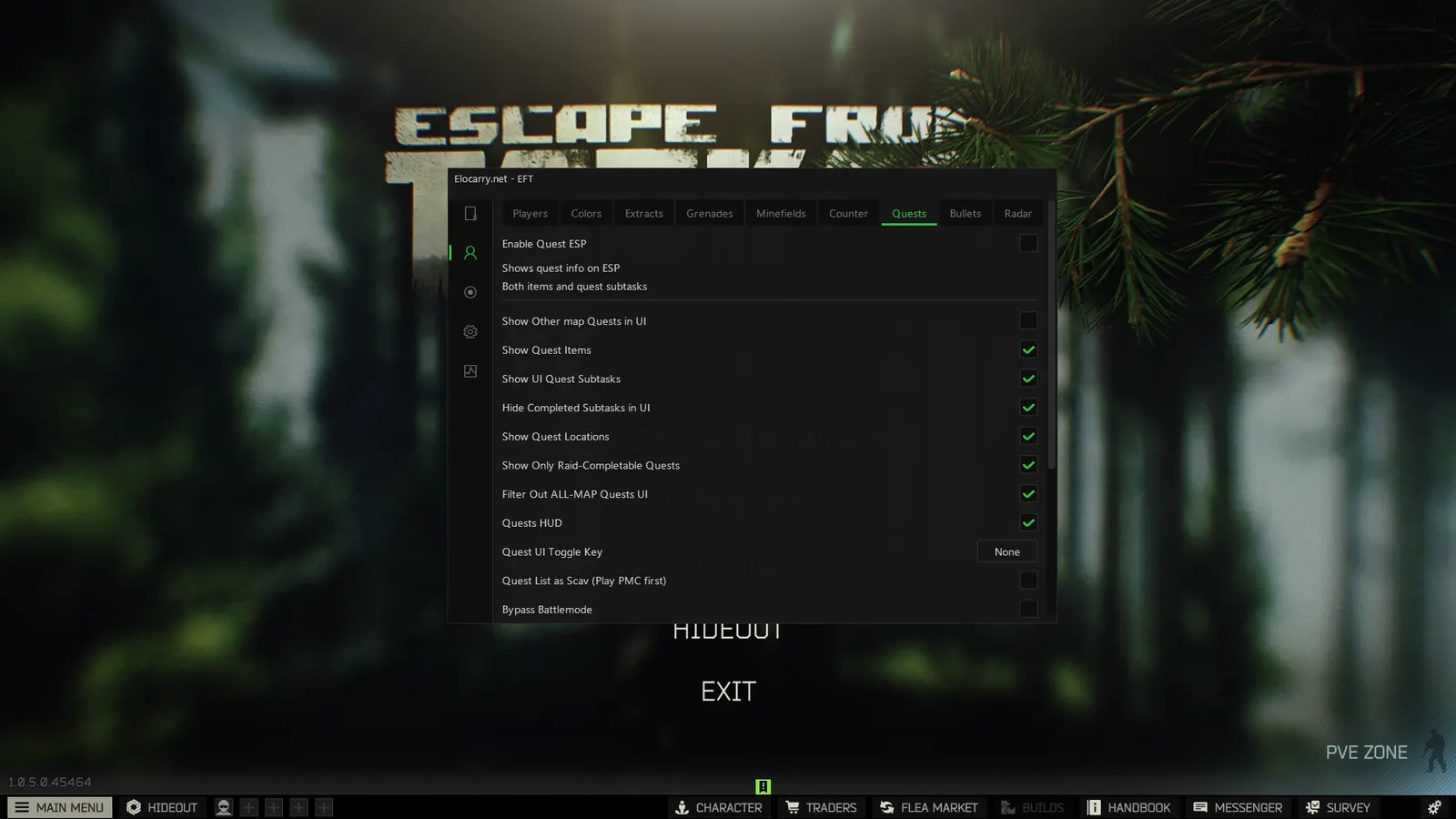
Quest ESP for the reworked task system
Under the old chain system you usually had one objective per trader in your head. With tasks handed out in groups of two to four per loyalty level, you are running several at once, from several traders, across the same raid.
Quest ESP marks objectives, quest items, beacons and markers, so you can see which of your live tasks a given building actually serves before you commit to clearing it. With kill objectives now shared across a squad, a group can work the same task list together instead of splitting up to chase individual progress.
Loot ESP and value filtering for the new economy
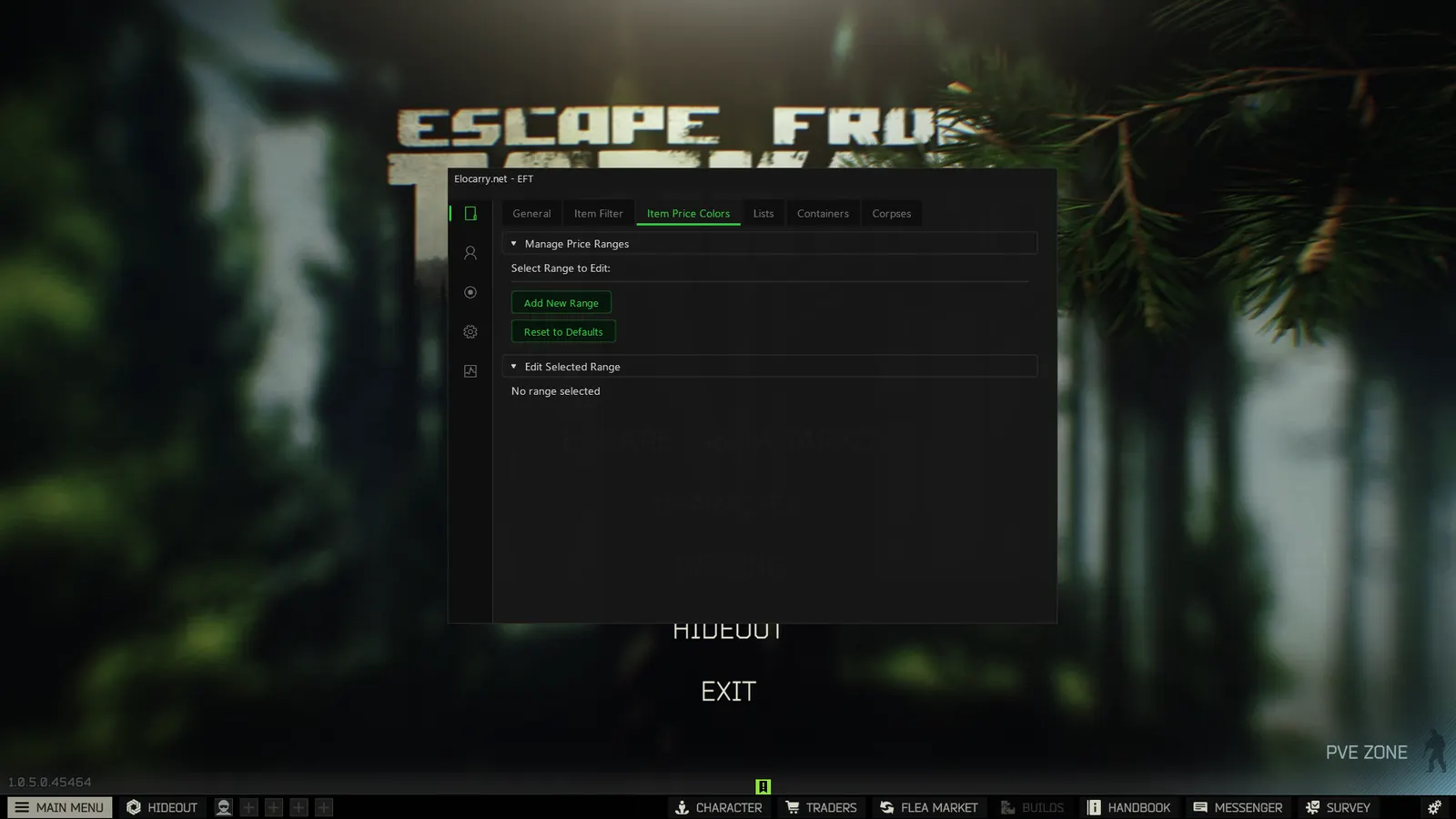
The 5% Flea Market fee, the reworked trader resale values and the arrival of TerraGroup documentation all push the same decision: is this item worth the slot?
EFT loot and player ESP covers items, containers and corpses, with advanced loot filtering by minimum value plus whitelist and blacklist, and price colour ranges you set yourself so a glance tells you which bracket something sits in. There is a searchable item browser for the times you want to find one specific thing. Hideout materials and high-value barter items are ordinary loot to the filter, which is exactly what you want now that hideout construction needs fewer Found in Raid items.
One honest note: the filter works on item value and your own lists. It is general item and loot visibility, not a dedicated “TerraGroup documents” category, and we are not going to claim otherwise until the live build says so.
Player ESP and radar for a busier map
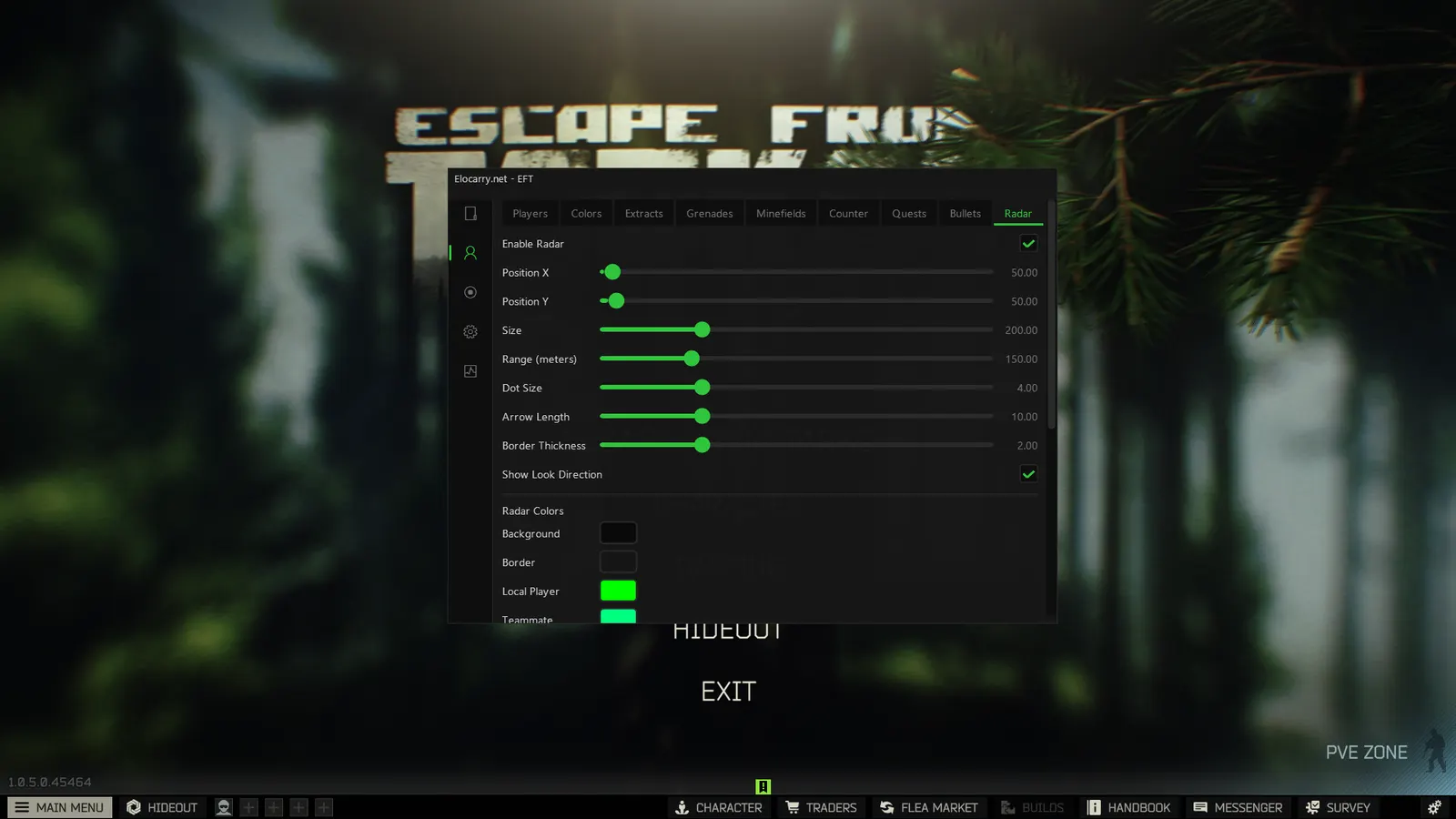
Black Division AI on more locations, seasonal raids full of players on fresh kit and the usual mix of PMCs, Scavs and bosses all add up to more unknowns per raid.
Player ESP covers PMCs, Scavs, AI and party members with names, distance, health, weapon and skeleton, and there is a player counter that breaks the lobby down by PMC, Scav, boss, AI, party and total. The radar puts the same picture on a clean overhead view, which is the calmer way to pick a route around a fight rather than through it.
Extract ESP for getting the documents out
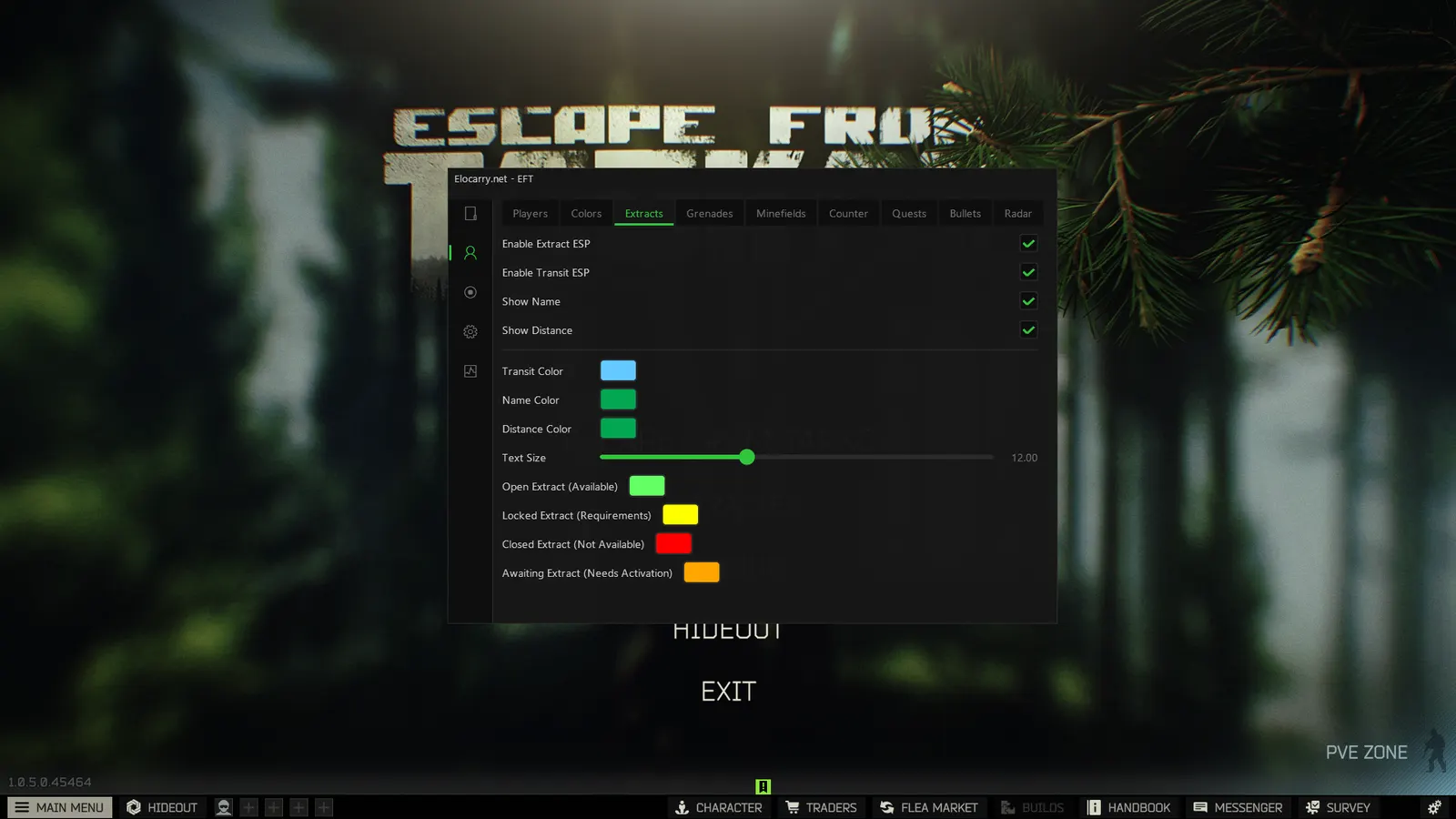
None of the above counts if you die on the way out with a bag of Battle Pass progress and half your task objectives finished. Extract ESP shows extraction points with their state, open, locked, closed or awaiting, laid over the map, so you always know which exits are actually available from where you are standing.
That matters most on the maps the document pools push you toward. If Factory or The Lab are not maps you know well, seeing the exits from the moment you spawn is the difference between a completed reward tier and a lost one. For the map knowledge itself, learn Tarkov extraction routes first and treat the overlay as backup.
Combat features
The combat side is configurable rather than fixed. The EFT aimbot fires on your own aim key with visibility and team checks, adjustable FOV, manual hitbox selection across head, neck, chest, pelvis and stomach, prediction and target priority you set. Silent aim lands rounds without the obvious crosshair snap. No recoil and no sway sit alongside recoil control with separate horizontal and vertical adjustment, plus thermal vision, visor removal and an editable FOV.
Everything there is a toggle. Dialled down, it reads as a steady player. Turned all the way up, it does not, which is the point of the section below.
Running the Kord Breach season
Quest, loot and extract ESP for the reworked task system, a live radar, and 24/7 setup help in Discord.
Standard and Rage are two different builds
Standard is the build described above. The current product page lists 53+ Standard features across aimbot, ESP, visuals and misc systems, and it is the one built to be run without announcing itself.
Rage is a separate, optional build with its own pricing. It carries movement options such as high jump, long jump, fast duck, no inertia and infinite stamina, combat and weapon controls including no recoil, no sway, no spread and no malfunction, view and visual controls such as Owl mode, third person, thermal and night vision, world controls including doors ESP, door opening and grenade prediction with a live overlay, and an automation option in the form of a KD dropper.
Rage is loud by design. It is not Standard with extra toggles, it is a different way to play, and it draws attention to match. Pick deliberately.
Elocarry 1.1.0+ support
The Elocarry Escape From Tarkov build supports EFT 1.1.0+, and updates are delivered through the Elocarry launcher, so keeping current is a case of launching it rather than reinstalling anything. The product page lists support for the BSG Launcher and Steam, and the build behaves the same in PvE as it does in standard PvP raids.
Two things are worth saying plainly, because the alternative is the kind of promise nobody should believe.
First, check live product status after any game or anti-cheat update. That page exists precisely because builds get paused during a patch cycle, and a status check takes ten seconds against a raid that takes forty minutes. Right after a major patch like 1.1 is exactly when it is worth looking.
Second, no third-party software can give you mathematically zero account risk, and anyone telling you otherwise is selling something. What we can tell you is what we actually control: the build is maintained against the live game, status is published rather than hidden, and support is reachable in our Discord or through the support area if a setup step goes wrong. Plans and current pricing are on the pricing page.
If you want to read further before the season eats your evenings, the rest of our Escape From Tarkov guides cover maps, builds, extractions and the wipe cycle in more depth than a patch write-up has room for.
Frequently asked questions
What is the Escape From Tarkov 1.1 update?
Update 1.1.0.0 is the first major content patch after Tarkov's 1.0 launch. It went live on 3 August 2026 and added Kord Breach (Season 1), seasonal characters on separate servers, a free Battle Pass shared across Seasonal, PvP and PvE, a side-task rework tied to trader loyalty levels, shared squad task progression, a spectator camera, the QBZ-191 and the new 5.8x42 calibre, plus rebalanced traders, economy, hideout and insurance.
Is Kord Breach a full wipe?
No. Kord Breach is an opt-in seasonal mode with its own fresh character on separate servers. Your permanent PvP and PvE profiles, stash, hideout and achievements are untouched whether you play the season or skip it. The reset applies to the seasonal character only.
How often will seasonal characters reset?
Battlestate Games has said seasonal character progression resets automatically every four to six months, timed with a major content update and the start of the next season. Season 1 began on 3 August 2026. Watch the in-client season timer for the exact end date, since Battlestate has not committed to a fixed public one.
Is the Tarkov Battle Pass free?
Yes. The Battle Pass added in 1.1 is free and every reward can be earned through normal play. It runs in Seasonal, PvP and PvE, and progress and rewards are shared between all three, so a level earned on your PvE profile counts everywhere. You progress it by finding TerraGroup documentation in raids.
Can squad members help with tasks in update 1.1?
Yes, for a lot of them. Kill objectives can now progress for the whole group rather than only the player who landed the shot, which removes most of the kill-stealing frustration in squad play. Some PvP-flavoured conditions, such as headshot or duel-style milestones, are expected to stay individual so they keep their difficulty.
Does insurance work in Kord Breach?
No. No insurance is one of the six global modifiers applied to every Kord Breach seasonal character, so anything you lose in a seasonal raid is gone. Insurance still works normally on your permanent PvP and PvE profiles, where 1.1 raised prices, made returns more reliable and added a faster, more expensive Jaeger tier.
Is Elocarry updated for EFT 1.1?
Yes. The Elocarry Escape From Tarkov build supports EFT 1.1.0+ and updates are delivered through the Elocarry launcher. Both the Standard and the Rage build are available. Check the live status page before you load in after any game or anti-cheat update, since builds are paused during a patch cycle.
Does Elocarry work in PvE and PvP?
Yes. The Escape From Tarkov build behaves the same in PvE as it does in standard PvP raids, which is why a lot of players use it to work through tasks and hideout materials without the grind. Support for any specific mode is confirmed on the live product and status pages, so check those rather than assuming.
Written up from Battlestate Games' official Escape From Tarkov patch notes. Figures and mechanics change between hotfixes, so check the source for the current wording.
Playing the 1.1 season with Elocarry
The Escape From Tarkov build is updated for 1.1.0+, with quest, loot and extract ESP for the reworked task system, plus a separate Rage build.